Artificial Intelligence
While "Artificial" refers to "putting" (programming) some natural process,
like "Intelligence", into in systems.
That is the easy part. the more complex and typically ill-defined aspect is
defining, and understanding,
that natural phenomenon. What is intelligence? Not just what does it look
like, not just what may be
intelligence symptom, but rather what is really, scientifically, intelligence?
As intelligence is a natural, intuitive and mostly subconscious, natural phenomenon
that we hope to
computerize into artificial form, we need to know and understand
what it is and how it operates, with substantial detail and precision.
Intelligence vs Automation
While automation seems like an intelligence related process, clearly, automation
is not intelligence.
Referring to automation as "artificial intelligence" seems like a fraudulent
misnomer.
Sophisticated Automation
While automation can grow in complexity and sophistication, like reflexes
and habits, they are still not intelligence,
regardless of their respective sophistication or however much they can be
used by intelligence.
they remain intelligence tools, like communication and many others.
Mimicking Intelligence
While mimicking intelligence aspects may require some intelligence to accomplish,
it is still not intelligence as,
for example, it still does not define intelligence and remains without effective
judgment, understanding,
tolerance, learning, evolving and many other fundamental aspects of intelligence.
Mimicking all aspects of intelligence, especially in a coherent and intelligent
way,
still requires, at least as a starting point, clearly defining effective intelligence.
What is Intelligence
While Intelligence is a natural process, found everywhere in nature and throughout
evolution, at all granularity levels,
it is best defined, simply, as "The ability to process knowledge". Possibly
surprisingly simple really, especially as
no AI, nor AI specialist has ever provided it clearly. So, intelligence is
an ability. The knowledge processing ability.
Which leads to the next questions: what is knowledge? and how can it be processed?
More so, effective artificial intelligence can not be done without clear detailed
answers to these questions, as well as
a deep understanding of the implications.
What is Knowledge
Knowledge is the structure of reality, as well as models thereof.
|

SECURE COLLABORATION
Knowledge Processing
While effectively defining knowledge, knowledge processing, knowledge processes
and knowledge processors,
along with understanding their causes, implications, operations and consequences
is more substantial.
" Akhu Sono" published
" Artificial Knowledge & Intelligence"
introducing and mapping these and related considerations.
Knowledge Processor
The DNAOS platform contitutes the first artificial knowledge processor, operating
based on its evolving inherited and acquired knowledge background, optimized
and correlated through its
metabolic knowledge processes, supported by its reflex (automation) space,
as well as interacting with the outside world through its streaming sensory
and motor interfaces.
Knowledge Resources
Knowledge is vast and intelligence has to deal with it in identifiable chunks.
We refer to these chunks as knowledge resources.
Knowledge is a resource and all its chunks are resources or resource collections,
where a resource collection is a resource and each resource can be nested,
to any debt, in an other resource.
Qualified Relationships
In the unlimited different knowledge resource types, there is a category that
is especially crucial and operational
for intelligence. They are resources like all others, but they have special
characteristics that enables them to
define, ualify and operate relationships between other resources. They are
qualified relationships.
They are key to reality, to intelligence, to knowledge and to all their operations,
while providing and defining meaning, purpose and behavior.
Knowledge Modeling
Managing and processing qualified relationships is key. By relating resources,
including other relationships,
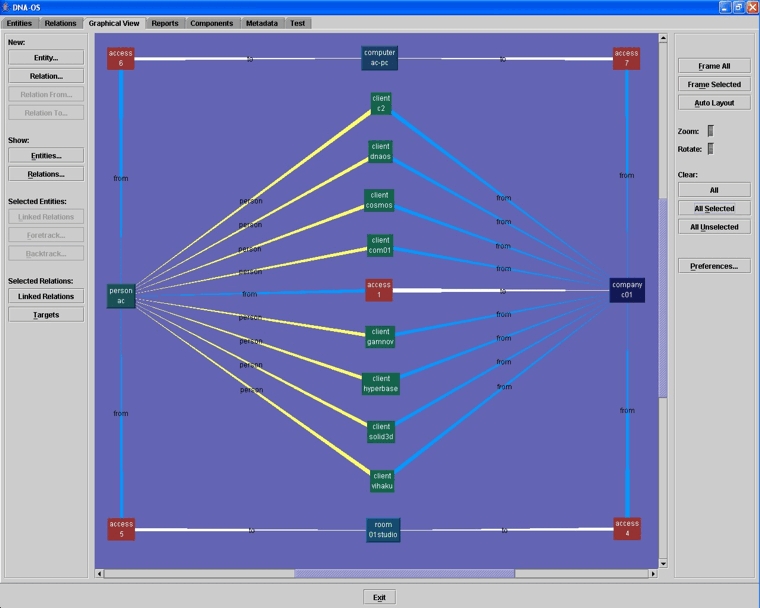
they define knowledge resource networks or graphs. It is then crucial to properly
model each qualified relationship.
Doing so naturally leads to modeling knowledge in effective knowledge graphs.
Processing these graphs is the art of intelligence.
Entitlement Modeling
|
Managing Complexity
One of the foremost advantages of managing qualified relationships is that
since each one provides the means for managing itself,
they represent a paradigm shift in managing complexity. It becomes as if complexity
manages itself.
The applications of this are far reaching.
Dynamic Classification
For example, data classification is key to content and sharing security.
While it may be possible to assign a basic classification for each piece of
data,
the effective classification of any piece of data varies depending of the
context which, in principle,
is never the same. As a simple example, a phone number may have been assign
a classification x,
but when it is associated with a name, then it may be a y. When these are
associated with an account,
and a transaction, and a time of day or night or weekend, the classification
could be quite different.
In fact effective classification is dynamic and based on every aspect of the
current context.
That is dynamic classification. The complexity of managing dynamic classification
is not trivial,
yet if a knowledge processing system has access to contexts and qualified
relationships,
it can navigate them to evaluate the current classification and use it to
determine
which accesses can be available, in the given context.
Entitlement Security
By intragrating dynamic classification (content), dynamic context management,
dynamic rights management,
with sophisticated encryption, authentication, and tracking enables effective
entitlement security
required for sharing and collaboration, as well as for rich applications with
virtual profiles and case management.
Optimizing Metabolic Streams
Natural and artificial knowledge-processors process knowledge-resource streams
two main level:
1. Internally, through continuous metabolic processes that correlate, optimize
and evolve the processor's
knowledge background, comprising all its inherited and acquire knowledge resources,
as well as 2. Externally, interacting with the "outside world" through various
sophisticated interfaces and converters,
both on input and output.
Sensory Stream Inference
Interacting with outside reality, through a variety of specialized input interfaces,
each knowledge processor acquires, filters, converts and integrates (infers)
knowledge resources,
to its knowledge-background, from the incoming sensory information streams.
Motor Stream Projection
In a similar, yet reversed, way, each knowledge processor interacts with its
outside reality
through a variety of specialized output interfaces, by projecting aspects
of knowledge-resource models,
from specific view points (selection), through specific perspectives,
into information streams, views and artifacts.
|